
Funeral Expenses Payment frozen since 2020
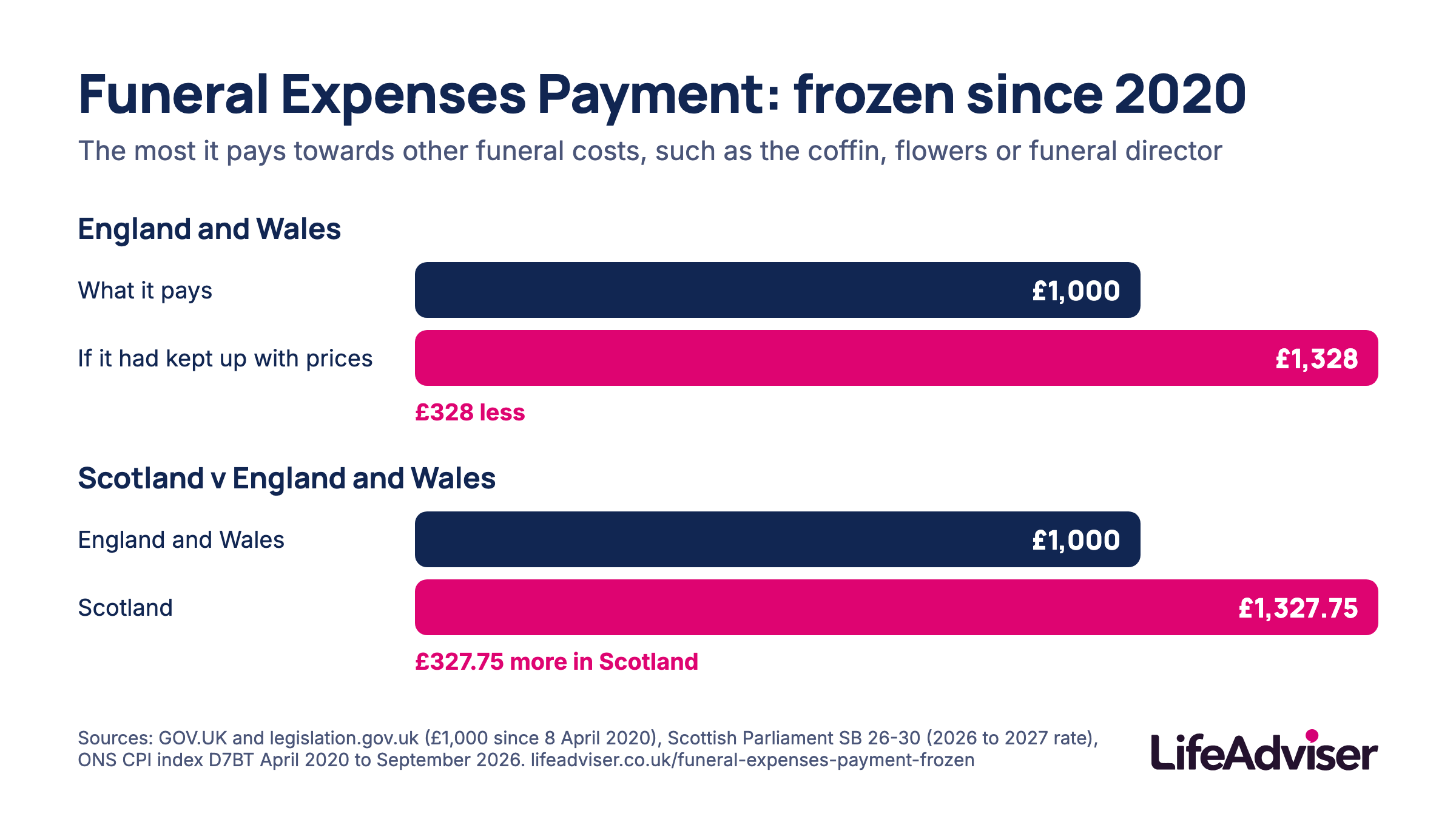
If you’re arranging a funeral and get certain benefits, this payment can help with the bill. Its £1,000 limit for costs such as the coffin and flowers hasn’t gone up since April 2020, and is now £328 short of what it would pay if it had kept up with prices. Every figure is sourced.
The key facts
- The limit has stayed at £1,000 since 8 April 2020. In England and Wales, that’s the most you can get towards other funeral costs, such as the coffin, flowers and funeral director’s fees (2020 regulations, current law, GOV.UK).
- Prices have risen by 32.8% since April 2020. The limit would be £1,328 if it had kept up. That’s £328 less towards the coffin, the flowers or the funeral director (2020 regulations, ONS).
- It’s worth less than in 2003. Today’s £1,000 buys 25.2% less than the £700 limit did in April 2003. That £700 would be £1,336 in today’s prices (Hansard, ONS).
- Scotland already pays £1,327.75 for the same costs. That’s £327.75 more, and almost exactly what the £1,000 would be if it had kept up with prices (Scottish Parliament, mygov.scot).
What it pays v what it would pay if it had kept up with prices
Here’s what you can get for other funeral costs, alongside what the limit would be if it had kept up with prices.
| Funeral Expenses Payment | What it pays | If it had kept up with prices | How much less |
|---|---|---|---|
| Other funeral costs | £1,000 | £1,328 | £328 |
The payment limit comes from GOV.UK. We used the Office for National Statistics prices to work out what it would pay if it had kept up. Our working is below.
Put another way, the £1,000 buys 24.7% less than it did in April 2020 (ONS).
The payment can also help with burial or cremation fees, travel to arrange or go to the funeral, and death certificates or other documents. The £1,000 is for everything else, like the funeral director, the flowers or the coffin (GOV.UK).
Scotland v England and Wales
Scotland has had its own payment, Funeral Support Payment, since 2019 (Scottish Parliament). It replaced Funeral Expenses Payment there (GOV.UK). The law makes Scotland put it up with prices (Scottish Parliament).
| Part of the payment | England and Wales | Scotland | Difference |
|---|---|---|---|
| Other funeral costs | Up to £1,000 | £1,327.75 | £327.75 more in Scotland |
| If there was a funeral plan | Up to £120 | £162.05 | £42.05 more in Scotland |
The England and Wales limits are set out in the current law. Scotland’s rates come from the Scottish Parliament briefing and mygov.scot.
So Scotland’s £1,327.75 is £327.75, or 32.8%, more than the £1,000 in England and Wales. It’s almost exactly the £1,328 the England and Wales limit would be if it had kept up with prices (current law, Scottish Parliament, ONS).
If the person who died was 18 or over and had a funeral plan, Scotland pays £162.05 for other costs. That’s £42.05, or 35.0%, more than the £120 limit in England and Wales (Scottish Parliament, current law).
Frozen since 2020
The limit rose from £700 to £1,000 for deaths on or after 8 April 2020 in England and Wales (2020 regulations). It has stayed there since. The amount is written into law, so the Government has to change the law to change it (current law).
| Limit for other funeral costs | Amount | Worth in September 2026 prices |
|---|---|---|
| From 7 April 2003 | £700 | £1,336 |
| From 8 April 2020 | £1,000 | £1,328 |
| Today | £1,000 | £1,000 |
The dates and limits come from Hansard, the 2020 regulations and the current law. Today’s values use ONS prices.
When the Department for Work and Pensions (DWP) announced the rise, it said the 43% increase was the first since 2003 (DWP). But prices had gone up a lot in those 17 years. By April 2020 you needed £1,006 to buy what £700 bought in April 2003. So the rise to £1,000 didn’t quite make up for the price rises since 2003 (Hansard, 2020 regulations, ONS).
The DWP published its proposed benefit rates for April 2027 on 11 November 2026. Funeral Expenses Payment isn’t on that list (DWP).
In 2024 to 2025, the DWP paid £50 million in Funeral Expenses Payments, compared with £52 million the year before. It also wrote off £47 million of funeral payment debt because there was no estate to take it back from (DWP). An estate is the money and property left by someone who has died (GOV.UK).
How we worked it out
We used the consumer prices index (CPI), the Office for National Statistics (ONS) measure of changes in everyday prices. The figures use September 2026 prices, the latest the ONS has published (ONS).
The index was 108.5 in April 2020 and 144.1 in September 2026 (ONS).
144.1 ÷ 108.5 = 1.328 (prices up 32.8%)
We applied that price rise to the limit to see what it would pay if it had kept up.
£1,000 × 144.1 ÷ 108.5 = £1,328
The shortfall is the difference: £1,328 less £1,000 is £328.
To work out how much less it buys, we divided the earlier price level by the latest one.
108.5 ÷ 144.1 = 0.753, so £1 buys 24.7% less
For the older limit, we used the April 2003 index of 75.5 (ONS).
£700 × 144.1 ÷ 75.5 = £1,336 (£1,336.03 before rounding)
£1,000 ÷ £1,336.03 = 0.748, so today’s £1,000 buys 25.2% less than £700 did in April 2003
We also worked out what the 2003 limit was worth by April 2020, when it last went up.
£700 × 108.5 ÷ 75.5 = £1,006 in April 2020 prices
For Scotland, we compared its published rates with the limits in England and Wales (Scottish Parliament, current law).
£1,327.75 less £1,000 = £327.75, and £327.75 ÷ £1,000 = 32.8% more
£162.05 less £120 = £42.05, and £42.05 ÷ £120 = 35.0% more
We rounded to the nearest pound, kept Scotland’s published rates to the penny and rounded percentages to one decimal place.
We’ll update these figures with October’s prices when the ONS publishes them on Wednesday 18 November 2026 (ONS).
What this means for you
You could get Funeral Expenses Payment if you’re arranging a funeral and you or your partner get Universal Credit, income-related Employment and Support Allowance, Pension Credit or Housing Benefit. You can still claim if you’ve applied for one of these and are waiting to hear. There are also rules on how you were related to the person who died (GOV.UK).
How much you get depends on your circumstances and other money available, including an insurance payout or money from the estate. The payment will usually cover only part of the funeral bill (GOV.UK).
If the person who died had a pre-paid funeral plan, you can get up to £120 for things the plan doesn’t cover (GOV.UK).
- Apply within 6 months of the funeral. This deadline also applies if you’re waiting for a decision on a qualifying benefit (GOV.UK).
- You can claim before the funeral. You’ll need the funeral director’s invoice or signed contract. Estimates aren’t accepted (GOV.UK).
- Claim by phone or by post. Call the DWP Bereavement Service helpline, or fill in claim form SF200 and post it (GOV.UK).
- It comes back out of the estate. The payment is taken off any money you get from the estate of the person who died. A house or personal things left to a husband, wife or civil partner don’t count (GOV.UK).
- In Scotland, apply for Funeral Support Payment instead. You can apply until 6 months after the funeral (mygov.scot).
If you’d rather your family didn’t have to rely on this help, life insurance can leave them a cash sum to put towards the funeral bill. Our page on funeral cover explains how it works.
For journalists
You’re welcome to use these figures. Please credit LifeAdviser and link to this page.
Every figure is linked to its source below. For questions or comment, email paul@pjgfinancial.co.uk.
Use our chart
Free to use with a credit to LifeAdviser and a link to this page.
Last updated 15 November 2026. Next update 18 November 2026, with October’s prices.
Sources
- GOV.UK, Get help with funeral costs (Funeral Expenses Payment) (payment amounts, costs covered, qualifying benefits and recovery from the estate).
- GOV.UK, Funeral Expenses Payment, make a claim (claim deadline, claiming before the funeral and ways to apply).
- legislation.gov.uk, The Social Fund Funeral Expenses Payment (Coronavirus) (Amendment) Regulations 2020 (the increase for deaths on or after 8 April 2020 in England and Wales).
- legislation.gov.uk, The Social Fund Maternity and Funeral Expenses (General) Regulations 2005, regulation 9 (the current limits for other funeral expenses).
- DWP, Benefit claimants to get more cash to help with funeral costs, published 5 November 2019 (the announcement of the increase).
- Hansard, House of Lords, Funeral Services: Costs, written answer, 28 April 2003, HL Deb vol 647 cc87-8WA (the limit went from £600 to £700 from 7 April 2003).
- Office for National Statistics, CPI index, series D7BT (April 2003: 75.5; April 2020: 108.5; September 2026: 144.1).
- Scottish Parliament Information Centre, Devolved Social Security Benefits (SB 26-30), published 10 June 2026 (Funeral Support Payment rates and the legal duty to increase them with prices).
- mygov.scot, Funeral Support Payment: if the person who died was 18 or over (payment amounts) and who can apply and when (the 6 month deadline).
- DWP, Proposed benefit and pension rates 2027 to 2028, published 11 November 2026 (Funeral Expenses Payment isn’t in the list).
- DWP, Social Fund Account 2024 to 2025, published 17 December 2025 (Funeral Expenses Payments paid and debt written off).
Written by Paul Gillooly, Founder of Life Adviser. Last updated 15 November 2026.